Understanding Tarot Readings Online – What the Cards Reveal
·
Priya Sharma
Tarot is one of the most recognisable and enduring systems of divination in the world. Its 78 cards – divided into the Major Arcana and Minor Arcana – form a symbolic language that skilled readers use to illuminate your past, present, and potential future.
If you are considering an online tarot reading but are not sure what to expect, this guide will help you understand how tarot works and how to get the most from the experience.
A Brief History of Tarot
Tarot cards originated in 15th-century Europe, initially as a card game before evolving into a tool for divination and self-reflection. Over centuries, the symbolism of the cards has been enriched by influences from astrology, numerology, Kabbalah, and Jungian psychology.
Today, tarot is one of the most widely practised forms of divination worldwide. Its enduring appeal lies in its versatility – the cards can address virtually any life question – and the depth of its symbolic language.
How Tarot Works
A tarot reading begins with you – your question, your energy, your situation. The reader shuffles the cards while focusing on your question or intention, then draws cards and arranges them in a specific pattern called a spread.
Each position in the spread represents a different aspect of your question – past influences, present circumstances, future potential, obstacles, outcomes, and advice. The reader interprets the cards in each position, weaving them together into a coherent narrative that addresses your situation.
The interpretation combines the traditional meaning of each card with the reader’s intuitive impressions. A skilled tarot reader does not simply recite card definitions – they use the cards as a lens through which their psychic ability can focus and articulate insight.
The Major Arcana
The 22 Major Arcana cards represent significant life themes, spiritual lessons, and major transitions. When these cards appear in a reading, they signal that the situation involves deep, transformative forces. Cards like The Tower, The Lovers, Death (which represents transformation, not literal death), and The World carry powerful archetypal energy.
Major Arcana cards in a reading suggest that you are at a significant juncture – the forces at play go beyond the everyday and touch on your life’s bigger patterns and purpose.
The Minor Arcana
The 56 Minor Arcana cards represent the more practical, day-to-day aspects of life. Divided into four suits – Wands (passion and action), Cups (emotions and relationships), Swords (thoughts and challenges), and Pentacles (material concerns and health) – these cards address the specific circumstances of your question.
Minor Arcana cards provide detail and nuance. They show you the practical dynamics of your situation – who is involved, what energies are at play, and what actions might shift the outcome.
Common Tarot Spreads
Three-Card Spread (Past, Present, Future)
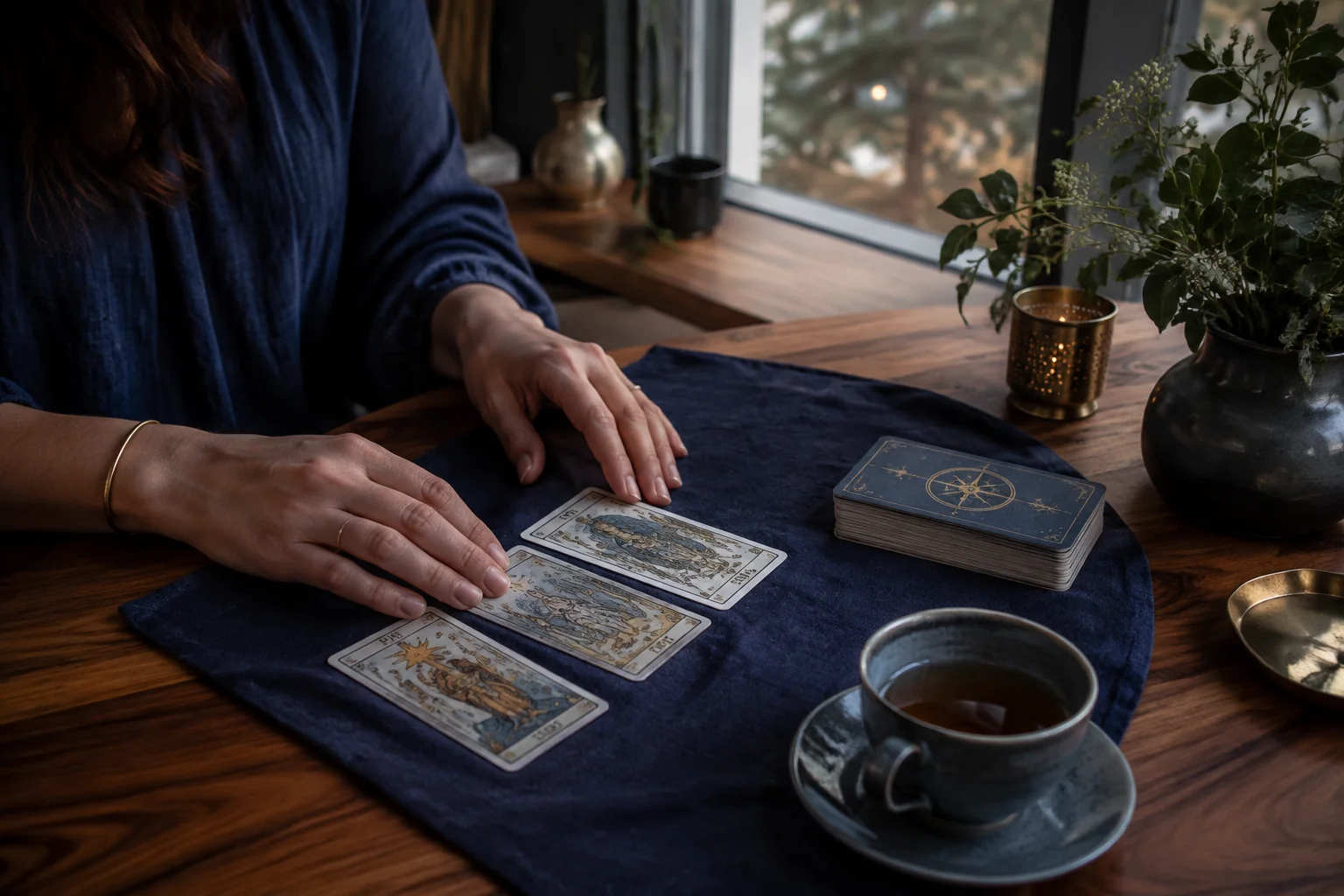
The simplest and most popular spread. One card represents past influences, one your current situation, and one the likely trajectory. It is ideal for quick, focused questions.
Celtic Cross (Comprehensive Reading)
A ten-card spread that provides a thorough analysis of your situation. It covers your current state, challenges, subconscious influences, recent past, potential future, your attitude, external influences, hopes and fears, and the likely outcome.
Relationship Spread
Cards are drawn to represent both parties in a relationship and the dynamic between them. This spread is particularly useful for understanding romantic partnerships, family relationships, or professional dynamics.
What to Expect in an Online Tarot Session
In an online tarot reading, the process is the same as in person – only the medium of communication differs. Your reader shuffles and draws cards on their end, then shares the layout with you via screen share, photo, or verbal description.
You begin by presenting your question or area of focus. If you prefer a general reading, the reader will draw cards without a specific question and interpret whatever themes emerge. Many readers begin with a brief centering moment to establish connection.
As the reading progresses, the reader interprets each card and its position, explaining how it relates to your situation. You are encouraged to ask questions, provide feedback, and explore any card that particularly resonates or puzzles you.
Getting the Most From Your Tarot Reading
Come with a clear question, but keep it open-ended. Rather than asking yes/no questions like “Will I get the job?” try framing it as “What do I need to know about my career path right now?” Open questions allow the cards more room to provide useful guidance.
Take notes during or immediately after the reading. Card meanings and positions can be complex, and capturing the key points helps you reflect on them later. Many people find that a tarot reading’s full significance becomes clear over days or weeks as events unfold.
Remain open to messages you did not expect. Tarot has a way of addressing what you need to hear rather than what you want to hear. The most valuable readings often contain surprising insights that shift your perspective.
Tarot and Free Will
One of the most important things to understand about tarot is that it shows potential, not destiny. The cards reflect the current trajectory of your energy and circumstances, but you always retain the power to make different choices.
A skilled reader will frame their interpretation in terms of possibilities and advice rather than fixed predictions. The purpose of tarot is to empower your decision-making, not to replace it.
Is Online Tarot as Effective as In-Person?
Many people wonder whether the physical distance of an online reading diminishes the accuracy of tarot. The short answer is no. Psychic connection does not require physical proximity. Experienced readers report that online readings are equally accurate and often more convenient for both reader and client.
The quality of the reading depends on the reader’s ability, not the physical format. A gifted tarot reader delivers the same depth and accuracy whether you are across the table or across the world.
Leave a Reply